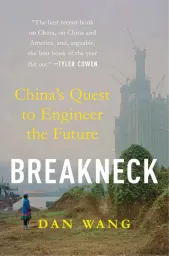
Review
This is another one of the books that I have been wanted to pick up for a long time. It just had a long lead time to reserve at the library. And there was no e- or audio-book version of the book available. So, I waited.
The central thesis of the book is that America is a country of lawyers and China is a country of engineers. The book is structured as a collection of six or so long essays - the last one is the conclusion. The chapter on China’s one-child policy was especially heart-wrenching. I had known about it from afar, but the stories I read in this book, brought tears to my eyes.
While reading the book, I kept wondering about India’s place in this world, and whether India was more lawyerly or a more engineering state. I could not come to a clear answer. Maybe we are somewhere in the middle, where we do have lawyers suing the government and corporations and the courts are kind of independent, but in important matters, these things can be side-stepped in a way.
This is a timely read. If you’re interested in China, or the US, or the current world order, give it a read. If you’re interested in tech, give this a read. It is fast paced and a fun read.
Notes
Rather than redistribute resources from the rich to the poor, the state builds infrastructure in Guizhou. Lenin used the term “com-manding heights of the economy” to refer to strategic sectors like power generation and transportation. In Guizhou, the commanding heights may well be seen from its tall bridges.
A different way to look at socialism.
China’s policymakers have declined to be bound by some of the fundamental tenets of Wall Street investors-reduce investment, shrink assets, produce profitability—all of which emphasize effipciency. Perhaps it will trigger financial distress in the future. So far, however, building big has improved the lives of regular people, not just a narrow set of elites. This lack of emphasis on efficiency has been key to another Chinese success: Part of the reason that China dominates advanced manufacturing technologies is precisely because it tolerates lower profits while cultivating a large workforce.
Embracing process knowledge means looking to people to embody eternity rather than to grand monuments. Furthermore, instead of viewing “technology” as a series of cool objects, we should look at it as a living practice. That is closer to the approach used in China and Japan.
How can the United States do better? As a starting point, it could develop a better understanding of how China has grown into a technology superpower. If members of Congress continue to resort to the laziest explanations (“they’re just stealing all our IP”), then the United States will never grasp the importance of building up process know-edge. And it will fail to gain urgency to fix its technological deficiencies.
My sense, while I watched the crackdown unfold in China, was that Beijing was trying to avoid the economic structure of the modern United States. Over the past two decades, the major American growth stories have been in Silicon Valley on one coast and Wall Street on the other: Subsequently, both tech and finance have been blamed for many social ills. If there is an era of American innovation that attracts Beijing, it might be the Silicon Valley of the 1960s and 1970s. Chipmakers like Intel were hitting their stride, becoming, in part, major suppliers to the Pentagon and NASA. That was a period when tech companies manufactured stuff, employed big workforces, and minded the state’s national security needs.
Is that really bad?
Paths into this note
2 notes lead here
-
It was such a breath of fresh air, both because I have not read a book like this before in my life, and because the last two books I've read - The Courage to be Happy and Breakneck were non-fiction books.
-
It wasn't only dread though. I was happy at the thought of going back home, going back to my rhythms and routines, to walking around Kumpula with Savya. My library had reserved a copy of Breakneck for me. I was excited to start reading it.